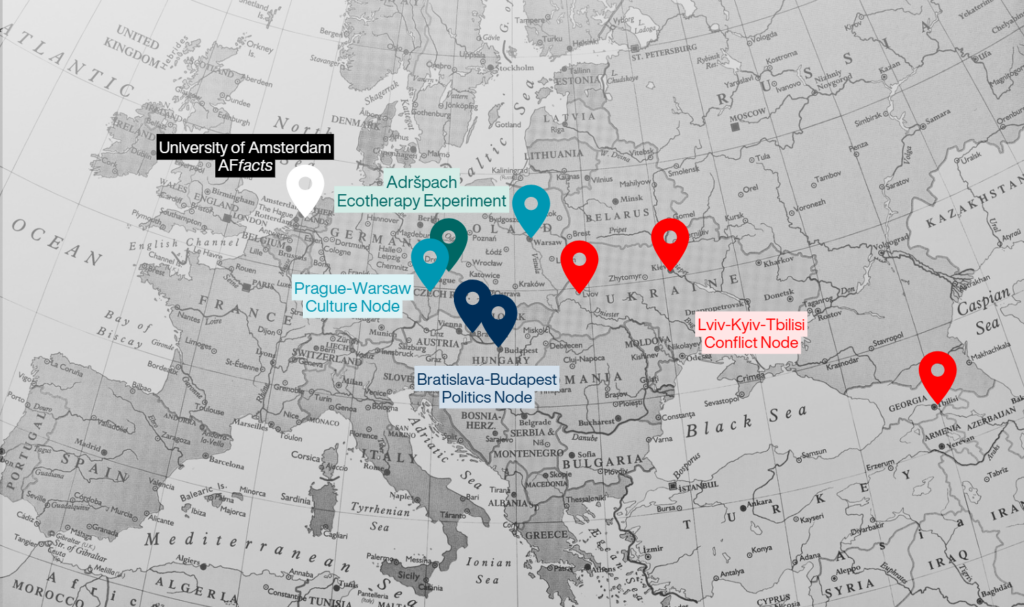
Project
Basic info:
Title: Emotions and bodies in fact-based media production: Integrating affective and embodied knowledge into journalism and documentary filmmaking (AFfacts)
Host institution: University of Amsterdam
Funded by: European Research Council (ERC)
Grant agreement ID: 101220216
Received funding: 1 500 000 EUR
Period: 2026/2/1 – 2031/1/31
EU factsheet: Emotions and bodies in fact-based media production: Integrating affective and embodied knowledge into journalism and documentary filmmaking | AFfacts | Project | Fact Sheet
Affacts is a five-year research project based at the University of Amsterdam. The Affacts team investigates, theorizes, and tests the role of bodies and emotions in journalism and documentary work.
In journalism and documentary work, emotion and the body have for a long time been treated as a liability: a source of bias, trauma, and other risks. Such an approach prevents us from seeing the productive side of emotions and bodily experiences. In Affacts, we look into the epistemic value of emotions and bodies – how they limit and enable what media professionals know.
We aim to empirically, theoretically, and practically integrate emotions and bodies into fact-based media epistemologies. Our project aims to help journalists and documentary makers move from a dichotomic to more holistic view of their profession and restore their connection with audiences. We also develop new approaches to supporting mental health in the news industry.
————————————————
Right now, the Affacts team is busy conducting ethnographic research among media professionals working in three production “nodes” – journalism and documentary making about politics, conflicts, and culture. The focus on political journalism, war reporting, and cultural journalism reflects the diversity of these beats’ emotional styles: the traditionally un-emotional, disembodied coverage of politics; the ubiquity of emotions, trauma, and physical risks in conflict reporting; and the ‘emotional exceptionalism’ and relative subjectivity of cultural and artistic journalism. Together, these beats show the diversity of the epistemic value of emotions.
We conduct observations, interviews, shadowing, and online research in Poland, Czechia, Slovakia, Hungary, Ukraine, and Georgia. This region is politically diverse with a wide range of media freedom levels and rich media history. Due to this diversity, it serves as a laboratory of diverse media production ecosystems, organizational cultures, epistemologies, and emotional styles. Yet, we address issues relevant beyond the region – analyzing trust, empathy, and affective proximity as sources of information and nuance in reporting, and discussing trauma and stress caused by violence, political pressure, and democratic backsliding as incentives for innovation.
In the second stage, the team will work with the Advisory Board to theorise the ethnographic research findings and integrate emotions and bodily experiences into media knowledge production.
Finally, we will bring in mental health professionals and experiment with a series of nature retreats for media professionals. We want to test whether and how nature-based therapy – a very promising trend in mental health care – can enhance journalists’ and documentary makers’ emotional literacy and mental well-being.